
Many scam victims do not realise for a long time that they are being scammed. They see high profits on a platform, try to withdraw and instead receive a bill for “taxes”, “fees” or a “verification”. They think it is a technical problem. In reality the money was never invested.
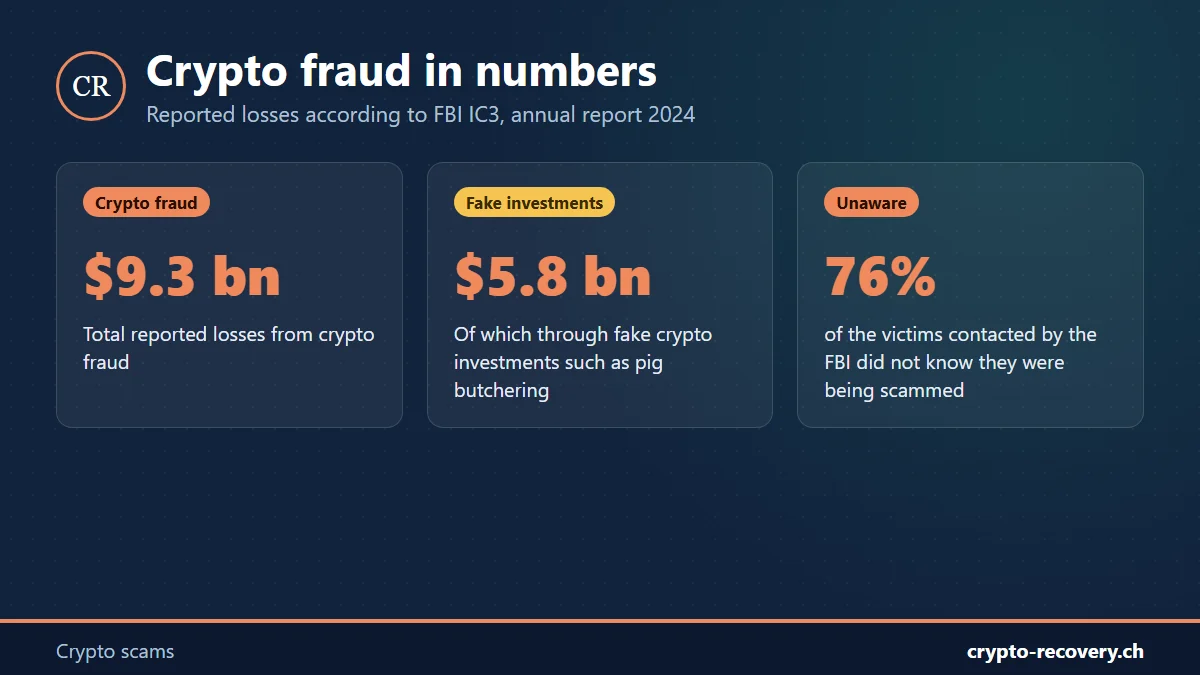
This is not an isolated case. According to the 2024 annual report of the FBI Internet Crime Complaint Center, 9.3 billion US dollars in crypto fraud losses were reported there alone, 5.8 billion of it through fake crypto investments. In one FBI operation, 76% of the victims contacted did not know they were being scammed.
This guide shows the 10 most common schemes and includes a checklist you can use to find out in two minutes whether you are affected.
Key points
- If you have to send money before you can withdraw, it is almost always a scam.
- No legitimate service asks for your seed phrase or wants remote access to your computer.
- A scam is often followed by a second wave: so-called recovery firms that promise to get your money back for an upfront fee.
- Stolen coins cannot be recovered technically. The police are responsible.
Checklist: Am I being scammed right now?
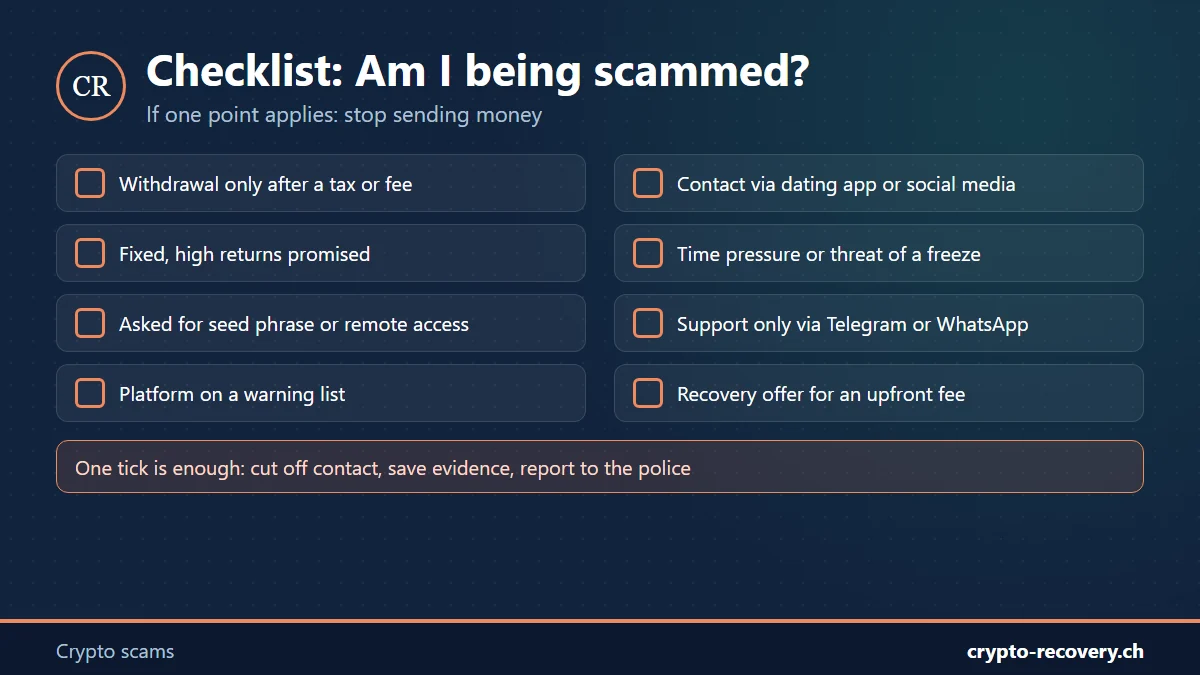
Go through the points honestly. If even one applies, do not send any more money and talk to the police.
- ☐ You cannot withdraw your profits and are asked to pay taxes, fees, a deposit or an “unlock fee” first.
- ☐ The contact started on a dating app, social media, a “wrong number” WhatsApp message or a call you did not ask for.
- ☐ You are promised fixed, high returns, such as several percent per week.
- ☐ There is time pressure: a bonus that is only valid today, or an account that will otherwise be “frozen”.
- ☐ Someone wants your seed phrase, your private key or remote access to your computer, for example via AnyDesk or TeamViewer.
- ☐ “Support” can only be reached via Telegram or WhatsApp.
- ☐ The platform appears in the investor warnings of the Austrian Financial Market Authority or on another regulator’s warning list.
- ☐ After a loss, someone contacts you offering to recover your money for an upfront payment.
The 10 most common crypto scams
1. Pig butchering: trust first, then the money
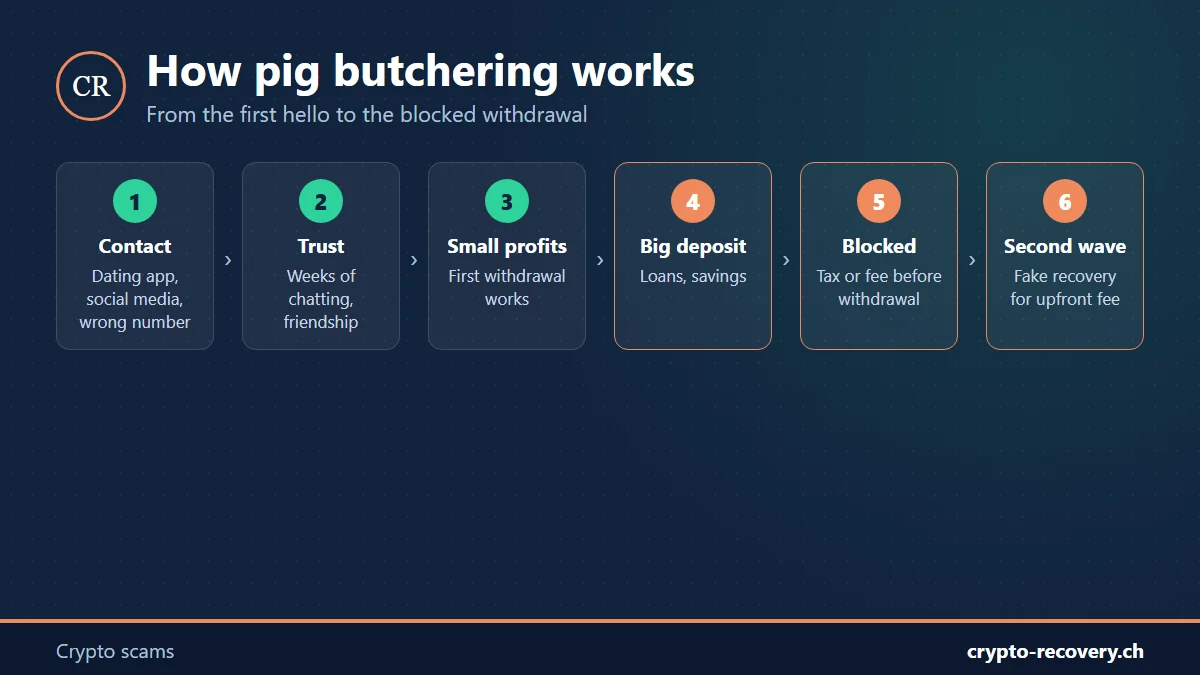
The name comes from Chinese and describes “fattening the pig” before the “slaughter”. Over weeks the scammers build a friendship or relationship, often via dating apps, Instagram or a supposedly misdirected message. Only then do they talk about their success with crypto and show you “their” platform. At first small amounts can even be withdrawn. That builds trust for the large deposits.
2. Fake platform: withdrawals only for a fee
The platform looks professional and the balance grows every day. But the numbers are just a display on a website the scammers control. If you want to withdraw, you first have to transfer “capital gains tax”, an “anti-money-laundering check” or a “minimum deposit”. Then the next demand follows. A real exchange deducts fees from your balance and does not ask for a transfer in advance.
3. Seed phishing via SMS, email and fake websites
A message warns of a “security problem” with your wallet or an update you must confirm immediately. The link leads to a deceptively real copy of the manufacturer’s site that asks for your seed phrase. Paid search ads sometimes lead to such sites too. No wallet manufacturer ever asks for your words online. Why the seed phrase is so valuable is explained in the guide Seed phrase.
4. Wallet drainers: “connect wallet” and sign
A supposed airdrop, a free NFT or a tool to “fix” your wallet asks you to connect your wallet and confirm a transaction. With this signature you allow the contract to take your tokens. Do not confirm anything you do not understand, and use a hardware wallet for larger amounts.
5. AI videos with well-known people
Fake videos and interviews show politicians, TV presenters or entrepreneurs recommending a “secret” crypto platform. Voice and face are generated with AI. Such ads run on YouTube, Facebook and Instagram. Reputable people do not advertise platforms with guaranteed profits.
6. Coin doubling and giveaways
“Send 0.1 BTC and get 0.2 BTC back.” This scheme often runs in fake livestreams or via hacked accounts of well-known people. Nothing ever comes back. A blockchain transaction cannot be reversed.
7. Honeypot tokens: you can buy, but not sell
A new token rises rapidly and is celebrated in groups. You buy, the value keeps rising, but selling fails. The contract is programmed so that only the developers can sell. In the end they pull the liquidity and the token is worthless.
8. Payouts in worthless tokens
A platform “pays out”, but not in Bitcoin or euros, instead in its own token. The wallet shows a high value. It cannot be sold anywhere because there is no real market. Unsolicited tokens with links to a “redeem page” belong in this category as well.
9. Shared seed phrase with a balance
In comments or chats someone seemingly “accidentally” reveals the seed phrase of a wallet with a large balance. Whoever imports it sees the money but cannot withdraw it. The wallet is set up so that withdrawals are blocked, or fees are missing. The fees you deposit are taken by the scammers immediately.
10. Recovery scam: the second wave
Anyone who has been scammed once ends up on lists. Shortly afterwards, supposed lawyers, authorities or recovery firms get in touch who can “trace the money on the blockchain”, for an upfront fee. The FBI explicitly warns about anyone claiming they can recover lost funds. How to spot dubious providers is explained in the guide Spot a reliable crypto recovery service.
Already lost money? What is realistically possible after a scam, who is responsible and why you should never make an upfront payment to anyone: Crypto scam: money back?
What to do if you are affected
- No further payments. Not for “taxes”, “fees” or to “unlock” the account either.
- Cut off contact. Stop replying to the scammers and do not install any programs they name.
- Save everything. Chat histories, emails, names, websites, wallet addresses, amounts, dates and transaction IDs.
- Report it to the police. In your country of residence, at the local police. In the US you can also file a report with the FBI IC3.
- Inform your bank and exchange. If you paid via a bank or a crypto exchange, report the scam there immediately.
- Switch wallets. If you shared your seed phrase or allowed remote access, the wallet is compromised. Move any remaining coins to a new wallet with a new seed phrase.
What I do and what I don’t
Crypto Recovery only restores technical access: forgotten passwords, faulty seed phrases, coins sent over the wrong network to your own wallet. Coins lost through fraud, scams or hacking cannot be recovered by me. Nobody can promise that in good faith.
What I offer is prevention: a personal security training on hardware wallets, backups and the mistakes that most often lead to losses. How I handle sensitive data is described on the page Security and process.
Store it safely instead of searching later: In a personal security training we set up your wallet and backup together so scammers find nothing to attack. Request a training
Frequently asked questions about crypto scams
How do I recognise a crypto scam?
Typical signs are guaranteed high returns, time pressure, contact via dating apps or social media and above all fees you have to pay before a withdrawal. Any request for your seed phrase or for remote access is also a clear warning sign.
What is pig butchering?
A scam in which the scammers first build trust over weeks and then get their victim to make ever larger deposits on a fake crypto platform. In the end no withdrawal is possible.
I can’t withdraw my crypto profits. Is it a scam?
If you are asked to transfer taxes, fees or a deposit before the withdrawal, almost certainly. Legitimate exchanges deduct fees from the balance. Stop paying and report it to the police.
Can you get money back after a crypto scam?
Technically, blockchain transactions cannot be reversed. Only the police can investigate and seize funds. Anyone promising to recover your money for an upfront fee is very likely a scammer themselves.
Where do I report crypto fraud?
To the police in your country. In the US you can also report it to the FBI IC3. In addition, inform your bank or the exchange you used to deposit.
Does Crypto Recovery help with scam cases?
No. Crypto Recovery only restores technical access, such as forgotten passwords or faulty seed phrases. In cases of fraud, scams or hacking, the police are responsible.